
About this service
FUE Hair Transplant
Are you experiencing hair thinning, receding hairlines, or visible bald patches? If you are looking for a solution to restore your hair density and achieve a natural-looking appearance, FUE hair transplantation may be an option worth considering.
FUE (Follicular Unit Extraction) is an advanced hair restoration technique that involves extracting individual hair follicular units from a donor area, usually at the back or sides of the scalp, and implanting them into areas affected by hair loss.
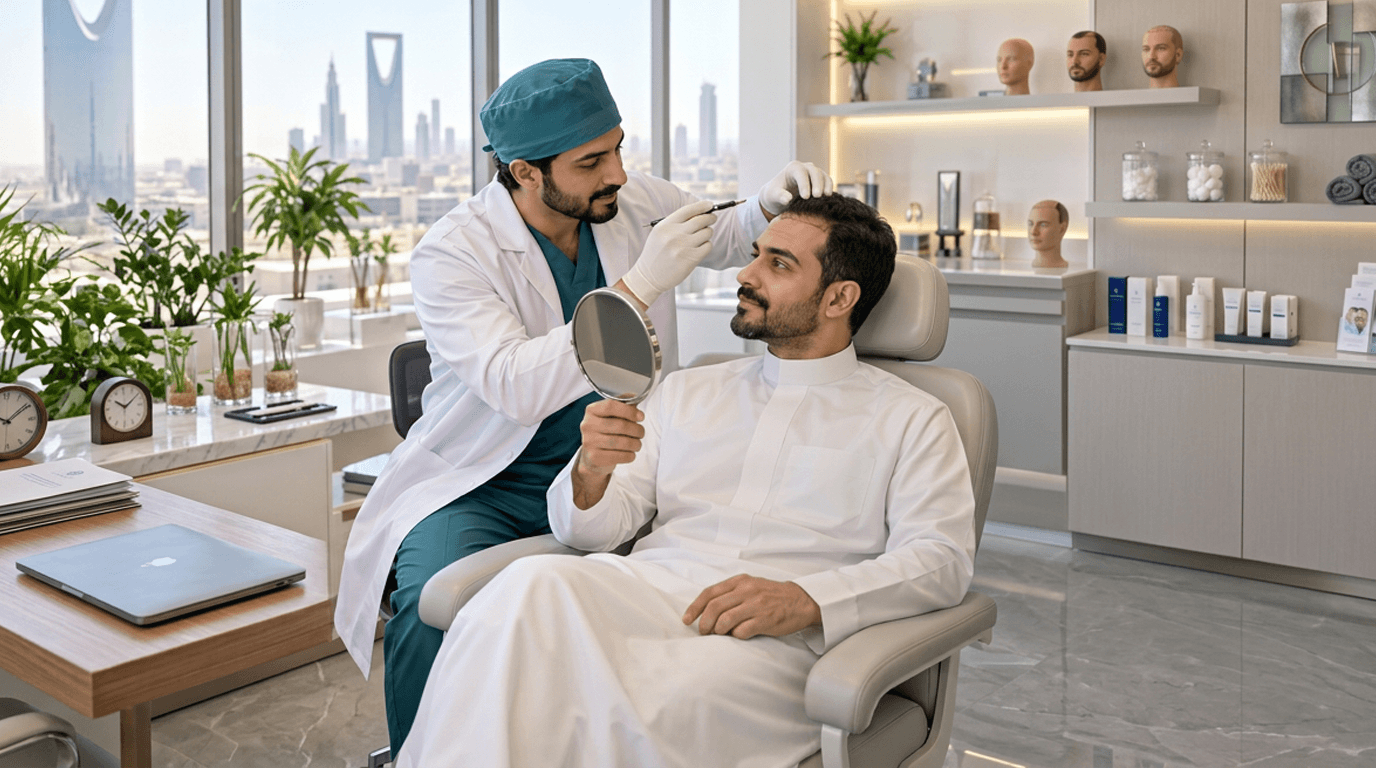
At PROF Clinic, your journey begins with a comprehensive medical assessment to evaluate your hair loss pattern, donor area, and suitability for the procedure. A personalized treatment plan is then developed based on your needs and realistic expectations.
Book your consultation today and explore your hair restoration options.
What Is FUE Hair Transplant?
FUE hair transplantation is a minimally invasive hair restoration procedure in which individual follicular units are extracted from the donor area and implanted into areas with thinning hair or baldness.
Unlike the traditional FUT technique, FUE does not require removing a strip of scalp tissue. Instead, individual follicles are extracted using specialized instruments, leaving small dot-like marks that typically heal over time.
FUE may be suitable for individuals experiencing male or female pattern hair loss, receding hairlines, or localized hair thinning, depending on their medical assessment.
Benefits of FUE Hair Transplant
FUE offers several potential advantages for suitable candidates:
- Individual Follicle Extraction: Hair follicles are extracted individually from the donor area.
- No Linear Donor Scar: Unlike FUT, FUE does not require removing a strip of scalp tissue.
- Natural-Looking Hairline: Hairline design can be customized to complement facial features.
- Precise Graft Placement: Follicles are implanted while considering their direction, angle, and distribution.
- Personalized Treatment Planning: The number of required grafts depends on hair loss severity and donor hair availability.
- Recovery Planning: Post-procedure recovery instructions are tailored to each patient's needs.
How Does the FUE Hair Transplant Procedure Work?
The procedure generally involves several carefully planned stages:
1. Medical Consultation and Assessment
The doctor examines your scalp, evaluates your hair loss pattern, and assesses donor area density to determine whether you are a suitable candidate.
2. Hairline Design
A personalized hairline is designed based on your facial structure, age, hair characteristics, and treatment goals.
3. Hair Follicle Extraction
Individual follicular units are extracted from the donor area using specialized FUE instruments.
4. Graft Preparation
The extracted follicles are examined and carefully prepared before implantation.
5. Hair Follicle Implantation
The prepared grafts are placed into the recipient area, taking into consideration hair direction, angle, and distribution to achieve a natural-looking appearance.
6. Aftercare and Follow-Up
Following the procedure, patients receive personalized aftercare instructions and follow-up recommendations to support the healing and hair growth process.
Who Is a Suitable Candidate for FUE Hair Transplant?
FUE may be suitable for individuals experiencing:
- Male or female pattern hair loss following medical assessment.
- Receding frontal hairlines.
- Visible bald patches.
- Reduced hair density in specific scalp areas.
- Certain types of scar-related hair loss, depending on the case.
- A desire to improve overall hair density and appearance.
However, not everyone experiencing hair loss is an ideal candidate. A medical assessment is necessary to evaluate the underlying cause of hair loss, donor hair availability, and overall suitability.
When Can You Expect FUE Hair Transplant Results?
Hair restoration is a gradual process that requires time.
Temporary shedding of transplanted hair may occur during the first few weeks following the procedure. This is a common part of the hair growth cycle and does not necessarily indicate treatment failure.
New hair growth typically begins over the following months, with gradual improvements in density and appearance. Final results may take approximately 12 months or longer, depending on individual healing and hair growth patterns.
Following your doctor's aftercare instructions and attending scheduled follow-up appointments are important parts of the recovery process.
Is FUE Hair Transplant Painful?
FUE hair transplantation is generally performed under local anesthesia to minimize discomfort during the procedure.
Some patients may experience temporary swelling, tenderness, or mild discomfort following treatment. The level of discomfort varies between individuals.
Your doctor will provide appropriate aftercare instructions and recommendations to support recovery.
FUE vs. FUT: What Is the Difference?
Both FUE and FUT are hair transplantation techniques, but they differ in how hair follicles are collected.
FUE Hair Transplant:
Individual follicular units are extracted directly from the donor area using specialized instruments, without removing a strip of scalp tissue.
FUT Hair Transplant:
A strip of scalp tissue containing hair follicles is surgically removed from the donor area and divided into individual grafts for implantation.
The most suitable technique depends on the patient's hair loss pattern, donor area characteristics, treatment goals, and medical assessment.
Why Choose PROF Clinic for FUE Hair Transplant in West Riyadh?
Choosing the right clinic is an important step in your hair restoration journey.
At PROF Clinic, we emphasize personalized medical assessment and careful treatment planning, with attention to:
- Evaluating hair loss patterns and donor area suitability.
- Personalized hairline design.
- Treatment planning based on individual needs.
- Careful consideration of graft placement and hair direction.
- Post-procedure guidance and follow-up recommendations.
Take the first step toward restoring your hair. Book your consultation at PROF Clinic in West Riyadh.
Frequently Asked Questions
Does FUE leave scars?
FUE typically leaves small dot-like marks in the donor area rather than the linear scar associated with FUT. Their visibility depends on individual healing, skin characteristics, and extraction technique.
How many hair grafts will I need?
The number of required grafts depends on the size of the recipient area, the density of the donor area, and your desired coverage. Your doctor will determine the appropriate number following an examination.
Are FUE hair transplant results permanent?
Transplanted hair can provide long-lasting results. However, outcomes vary depending on follicle quality, individual health, hair loss progression, and post-procedure care.
When can I return to work?
Recovery time varies depending on the procedure and individual healing. Some patients may return to desk-based work relatively soon, while strenuous activities should be avoided until cleared by the doctor.
Can FUE be used for beard transplantation?
Hair transplantation may also be performed in the beard area using specialized extraction and implantation techniques. However, beard transplantation requires a separate assessment and treatment plan.
Can I undergo a hair transplant if I am still experiencing hair loss?
Some patients may require medical treatment to manage ongoing hair loss before or alongside transplant planning. Your doctor will determine the appropriate approach based on your condition.